
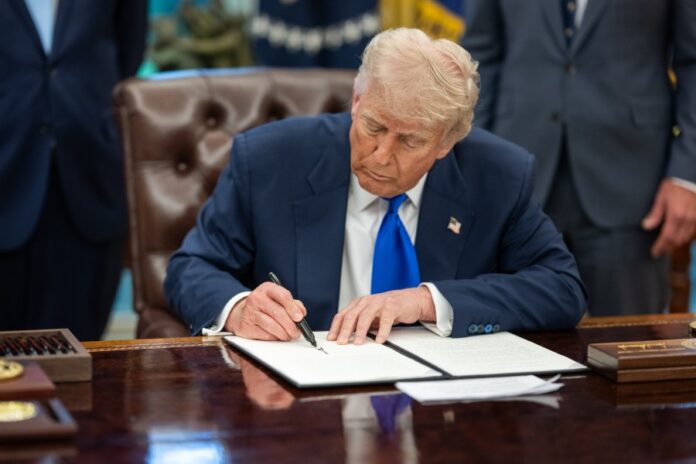
President Donald Trump is poised to unveil a significant initiative aimed at advancing nuclear energy in the United States, featuring $17.5 billion in low-interest federal loans to facilitate the deployment of Westinghouse AP1000 nuclear reactors nationwide. This funding, to be administered by the US Department of Energy, is intended to support the procurement of essential equipment for up to ten AP1000 reactors, distributed across five projects with two reactors each. This initiative is part of a broader strategy designed to enhance domestic energy production and address the rapidly increasing electricity demand driven by artificial intelligence data centers and expanding industrial activities.
In a bid to stabilize supply chains and lower project costs, the loans will principally aid the early bulk procurement of specialized reactor components. Seven utility companies have reportedly expressed interest in the program by signing letters of intent to participate. The Trump administration anticipates that this financial mechanism could reduce construction timelines by up to three years, with the new reactors projected to commence commercial operations around 2035 if everything proceeds as planned.
The nuclear energy initiative is a component of a larger $80 billion expansion project involving Westinghouse Electric Company, Cameco, and Brookfield Asset Management. The collaboration aims to initiate construction on approximately ten new reactors starting in 2026. To circumvent the cost overruns that impacted previous projects like the Vogtle Nuclear Plant in Georgia, Westinghouse plans to employ standardized reactor designs and fixed-price contracts. Notably, the Vogtle project’s costs escalated from an estimated $14 billion to over $30 billion before reaching completion.
Central to the project will be Westinghouse’s AP1000 pressurized water reactors, along with the AP300 small modular reactor design. The AP1000 technology is already in use at the Vogtle facility, which marked the introduction of the first new US nuclear reactors in decades during 2023 and 2024. The administration perceives nuclear power as a critical element of future energy security, with nuclear currently accounting for approximately 20% of US electricity generation. The planned expansion seeks to enhance reliable, carbon-free power generation while fostering economic growth and technological development.