
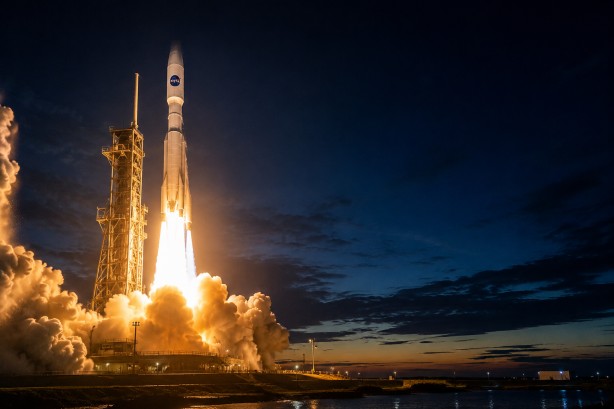
NASA’s Nancy Grace Roman Space Telescope has embarked on its mission to explore the cosmos after a successful launch from Florida. The $4.3 billion project aims to uncover new insights into exoplanets, galaxy formation, and some of the universe’s most profound mysteries. The telescope was launched on a SpaceX Falcon Heavy rocket from the Kennedy Space Center, marking a significant milestone for a mission developed over nearly a decade.
Unlike its predecessors, the Hubble and James Webb Space Telescopes, the Roman telescope is designed to complement their work rather than replace them. Equipped with a powerful 300-megapixel infrared camera, it will capture images with Hubble-like resolution but with a field of view that is at least 100 times larger. Each shot will encompass an area of the sky about 1.5 times the apparent size of the full Moon, offering an expansive look at the universe.
A key feature of the Roman telescope is its coronagraph, which is designed to block the overpowering light of stars, enabling scientists to study the planets orbiting them with greater precision. This tool is expected to lead to the discovery of previously unseen worlds, particularly older and colder planets that orbit closely around their stars. Roman is headed to the Sun-Earth Lagrange Point 2, a stable space location shared with the James Webb Telescope, from where it will conduct a wide array of observations over a planned five-year mission, with the potential for extension.
Researchers anticipate that the Roman telescope will offer new perspectives on dark matter, dark energy, distant galaxies, supernovae, black holes, and planets beyond our solar system. Its broad-field observations are also set to pinpoint targets for detailed follow-up studies by both Hubble and Webb. The mission’s first scientific images are expected by early 2027 after a period of testing and calibration, with NASA planning to release these images to the public, expanding access to this new wealth of astronomical data.
The launch of the Roman telescope is a notable achievement, especially after facing threats of budget cuts to NASA’s science programs. Despite previous proposals from the White House to terminate the project, Congress ensured its continuation by securing the necessary funding. With the Roman telescope now in space, NASA moves forward in its quest to better understand the expansion of the universe, the formation of planets, and the evolution of the cosmos over billions of years.