
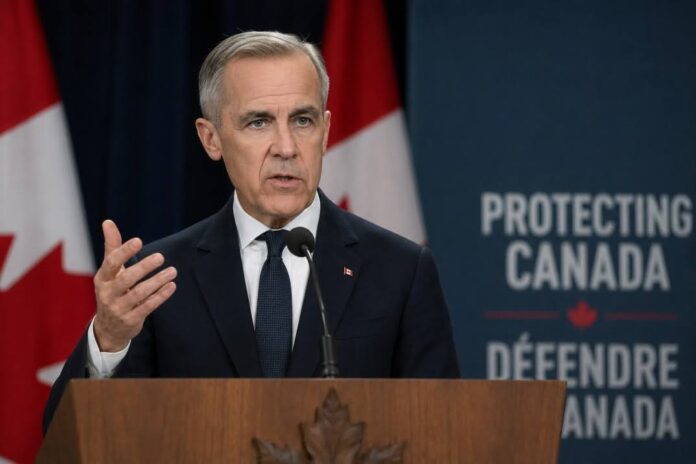
Prime Minister Mark Carney of Canada has vocally criticized the Trump administration, urging U.S. officials to abandon their current approach of mockery and engage earnestly in trade discussions. His comments come just as Canada prepares to implement retaliatory tariffs on American products, set to roll out in a matter of days. Carney highlighted that the insults directed at Canada undermine the dignity of the involved offices and stressed that meaningful trade negotiations could only proceed if Washington ceases its focus on superficial tactics and returns to substantial dialogue.
The tension between the two countries has been escalating, particularly following President Trump’s recent decision to rename Lake Ontario as “Lake America,” a move that was widely rebuffed in Canada. While the top U.S. trade negotiator downplayed the impact of the growing dispute, asserting that the economic consequences would affect Canada more than the U.S., he candidly noted that no trade talks are currently in progress. This standoff follows the breakdown of U.S.-Canada trade negotiations approximately a week ago, after which Washington imposed 50% tariffs on $20 billion worth of Canadian goods. In response, Canada, a major trading partner, announced its own $20 billion tariffs on American products, effective September 8, with consumers on both sides of the border likely to feel the impact on everyday items.
The U.S. trade negotiator attributed the failed talks to Canadian demands, including requests to reduce taxes on heavy-duty trucks, which he claimed were obstacles to reaching an agreement. He questioned Canada’s commitment to securing a deal, suggesting that any move by Canada to restrict American goods and services would prompt the U.S. to consider similar measures in retaliation. On the other hand, Canadian officials provided a contrasting explanation, pointing to internal disputes within the White House about who was leading the negotiations. Carney also noted that American negotiators viewed Canada’s protections for the French language as a contentious issue, despite these being well-established rights, particularly in Quebec.
President Trump has framed the conflict as stemming from Canada’s desire to reap the benefits of close ties with the United States without full integration, further accusing Canada of long-standing heavy tariffs on American agricultural products. The U.S. negotiator admitted there was confusion over what was being negotiated, indicating uncertainty about whether the breakdown was due to political or economic reasons. However, he maintained that the choice between the current tariffs and completely duty-free trade was never a realistic option.