
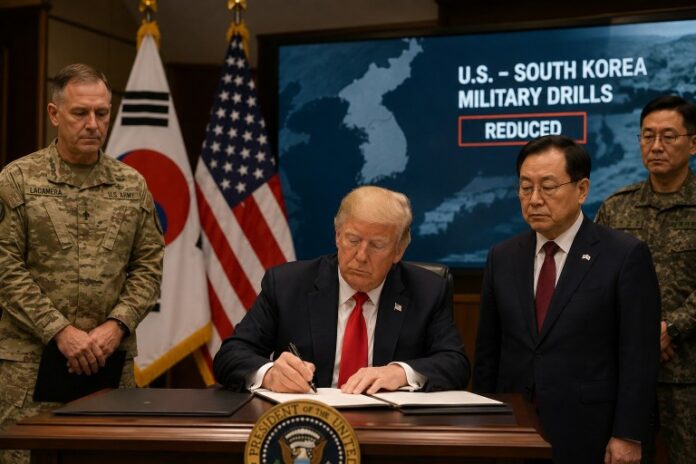
In a move that could impact military readiness, former President Donald Trump has directed a significant decrease in joint military exercises with South Korea. Trump cited the high costs and the potentially negative message these drills send to North Korea as reasons for his decision, which he linked to his favorable relationship with North Korean leader Kim Jong-un. The exercises, known as the Ulchi Freedom Shield, are set to begin as planned from Monday through August 27, involving approximately 18,000 South Korean troops alongside U.S. forces and personnel from several United Nations Command member states.
Although Trump aimed to reduce U.S. military involvement, it was too late to cancel the exercises entirely. He instructed Defense Secretary Pete Hegseth to scale back U.S. participation significantly. Despite Trump’s directive, South Korea’s defense ministry announced that the drills would proceed as originally scheduled. The decision comes amid concerns from U.S. and South Korean military officials that North Korea is acquiring valuable battlefield experience through its military cooperation with Russia in the ongoing conflict in Ukraine.
North Korean forces have been actively supporting Russian troops, deploying over 14,000 soldiers and supplying artillery ammunition and ballistic missiles. This collaboration has reportedly allowed North Korean troops to gain expertise in modern warfare technologies such as drones, GPS disruption, cyber operations, and missile systems. U.S. military officials have adapted the exercises to address these evolving threats, warning that North Korea’s newfound experience in Ukraine could enhance Pyongyang’s military capabilities upon their return home.
Trump’s decision to reduce military exercises is not unprecedented; he has previously scaled back or suspended major U.S.-South Korean drills during diplomatic engagements with Kim Jong-un. However, this latest reduction has raised concerns in Seoul regarding the future of the U.S.-South Korea alliance and regional deterrence efforts. South Korean experts warn that cutting back on these exercises could weaken preparedness and deterrence, offering only limited diplomatic benefits since North Korea has consistently demanded the complete cancellation of such drills.
Despite North Korea’s criticism of the exercises as a rehearsal for an aggressive war, and its threats of stronger military responses, South Korean officials maintain that the joint exercises are crucial for defending against an increasingly potent North Korean military. Pyongyang has also recently test-fired ballistic missiles in anticipation of the drills, highlighting the ongoing tensions in the region.